Managing a full API lifecycle today requires assistance from API management tools due to the rapidly evolving market and single-tool API testing limitations. A lot of companies today are shifting their focus from manual testing to automated API tools to accelerate proficiency in the entire API lifecycle.
Postman is a great platform used to build, test, document and manage APIs throughout their entire lifecycle. Postman is a widely used platform among developers and testers, but it comes with a few limitations and lacks advanced features. This is why we have found out 10 best 10 best alternative API management tools for API testing.
What Makes a Great API Lifecycle Management Tool Today?
Earlier API lifecycle management tools meant basic security, traffic management, manual processes, and operations, but that’s not enough in today’s market. A great API life cycle management tool today requires design-first API development with version control and governance. To ensure continuous validation of functionality, performance and security throughout the entire development and deployment, automated testing pipelines play a vital role. Additionally, production monitoring, governance, built-in security and compliance, Integration, and cost & performance optimization make an API lifecycle management tool outperform the competition.
API Testing vs API Lifecycle Management Tool
| API Testing | API Lifecycle Management Tools |
|---|---|
| Focus on Requests | UCover design to retirement |
| Manual Testing | CI/CD automation |
| Debugging | Governance + monitoring |
Top 10 Postman Alternative API Lifecycle Management Tools
Tool #1 – Best for Enterprise API Governance
SwaggerHub

| Characteristics | SwaggerHub |
|---|---|
| Best use case | Enterprise grade API design and standard lifecycle governance |
| Core strengths | Open API-native design and Centralized API version control |
| Who should use it | Large Enterprises Managing multiple APIs |
SwaggwerHub is a popular collaborative platform used for development, documentation and testing. This platform is developed by a Smarbear company who have built platforms like Swagger editor and Swagger UI. The platform comes with role-based access, version control, and team collaboration to assist organizations. The platform offers interactive API documentation generation and provides support for clients’ SDKs and server stubs.
Key Features
- API Design and Collaboration
- Governance and Standardization
- Automation and Integration
- Documentation and discovery
Tool #2 – Automated API Testing at Scale
Tricentis Tosca

| Characteristics | Tricentis Tosca |
|---|---|
| Best use case | Automated API regression testing |
| Core strengths | Model-based test automation, Scriptless testing |
| Who should use it | QA teams requiring high test coverage and automation |
Tricentis Tosca is one of the most popular model-based automation tools known for scalable automated API testing for applications. This api management tool offers end-to-end testing to achieve quality, speed and performance via innovative functional testing. Tricentis Tosca is used to build reusable, script-less test cases by DevOps teams to get higher automation rates.
Key Features
- Codeless API Testing
- Model-based Test Automation
- API Scan Feature
- API Simulation
- Comprehensive Protocol Support
Tool #3 – Best Open-Source Postman Alternative
Insomnia

| Characteristics | Insomnia |
|---|---|
| Best use case | Testing with open-source flexibility. |
| Core strengths | Clean UI, Open-source core, GraphQL & REST support |
| Who should use it | Developers and startups want a free, customizable API client. |
Insomnia API client is an AI-native API collaboration platform used by developers for testing. The platform is used to test, debug, and design any endpoint with MCP client support, advanced AI capabilities, GIT or cloud workflows. This is an open-source, popular desktop application that simplifies designing, debugging, and testing APIs with an easy-to-use interface.
Key Features
- Multi-protocol support
- API design and documentation
- API Testing and Debugging
- Environments and Variables
- Authentication helpers
- Collaboration and version control
Tool #4 – Microservices & DevOps Teams
Katalon Studio

| Characteristics | Katalon Studio |
|---|---|
| Best use case | End to end automation for APIs in the DevOps pipeline. |
| Core strengths | API + UI + Mobile Testing, Built-in CI/CD Support, Test Orchestration |
| Who should use it | DevOps team managing microservices architectures and continuous workflow |
Katalon Studio has recorded 1.1 million test cases creation and 40.4 million test executions yearly, helping users to save 10.6 million hours. This API management tool has provided 10.3x return on investment to users with automation. The platform supports tech stack integration to accelerate the quality of the API management life cycle with frameworks like Selenium (browser) and Appium (Mobile).
Key Features
- Test automation for multiple platforms
- Low-code and full-code support
- CI/CD & DevOps Integrations
- AI-assisted test creation
- Self-healing and smart execution
- Enterprise-scale capabilities
Tool #5 – Best Low-Code API Automation Tool
ReadyAPI

| Characteristics | ReadyAPI |
|---|---|
| Best use case | ELow-code functional and security API testing |
| Core strengths | Drag and drop interface and security testing |
| Who should use it | Teams requiring automation power without heavy scripting |
ReadyAPI from SmartBear is an enterprise-grade automated API testing platform designed for validating, automating, and scaling API quality workflows. It offers functional, performance, security and service virtualization for different API types, including REST, SOAP, and GraphQL. ReadyAPI is a UI-driven Hub that enables robust reporting and integration for agile DevOps lifecycles.
Key Features
- Functional testing and security testing
- Performance and load testing
- Service virtualization
- CI/CD Automation
Tool #6 – API Monitoring & Performance
Apigee

| Characteristics | Apigee |
|---|---|
| Best use case | API Monitoring, Analytics and Performance Optimization |
| Core strengths | Advanced Analytics Dashboards, Traffic Management, Monetization Capabilities |
| Who should use it | TOrganizations requiring deep monitoring and performance insights |
Apigee is Google’s cloud native API management tool that offers building, managing and securing APIs for any use case. The platform offers high-value/volume enterprise-grade security for dev engagement, ensuring consistent quality across the entire API lifecycle. The platform introduces a proxy layer between your backend services and API consumers to enforce policies and controls without modifying backend services.
Key Features
- API Security & Access Control
- Traffic management
- Analytics and monitoring
- Developer portal and API products
- API Lifecycle and governance
Tool #7 – Best for Secure API Development
Salt Security

| Characteristics | Salt Security |
|---|---|
| Best use case | Real-time API security posture management |
| Core strengths | AI-driven threat detection, API Discovery, Behavioral Analysis |
| Who should use it | Security focus enterprises protecting sensitive APIs in production |
Salt Security is an API security infrastructure that focuses on discovering, monitoring and protecting APIs from attacks. This API security hub offers continuous API posture management and runtime attack protection across cloud environments. The tool automatically detects shadow, zombie and unmanaged APIs in the system to avoid data breaches.
Key Features
- API Discovery
- Run-time threat protection
- API security posture governance
- Behavioral Intelligence
Tool #8 – Best for Collaboration & Documentation
Stoplight

| Characteristics | Stoplight |
|---|---|
| Best use case | Collaborative API design and Documentation |
| Core strengths | Visual OpenAPI Editor, Mock servers, Design-first workflows |
| Who should use it | Product and engineering team working collaboratively on API-first development. |
Stoplight is an API platform with an intuitive interface and thoughtful features that accelerate design, documentation, and development. This design-first tool helps teams develop, document, govern, mock, and collaborate on APIs. SmartBear acquired Stoplight on August 22, 2023, and Stoplight support is provided by the SmartBear community.
Key Features
- Comes with API design editor
- Custom governance rules
- Offers mock servers and documentation
- CI/CD Integrations and Git-centric workflows
Tool #9 – Best Budget-Friendly Tool
Hoppscotch
| Characteristics | Hoppscotch |
|---|---|
| Best use case | Free, Browser-based API testing |
| Core strengths | Fully open-source, REST, GraphQL and WebSocket support |
| Who should use it | Freelancers, students, and small teams needing a free postman alternative. |
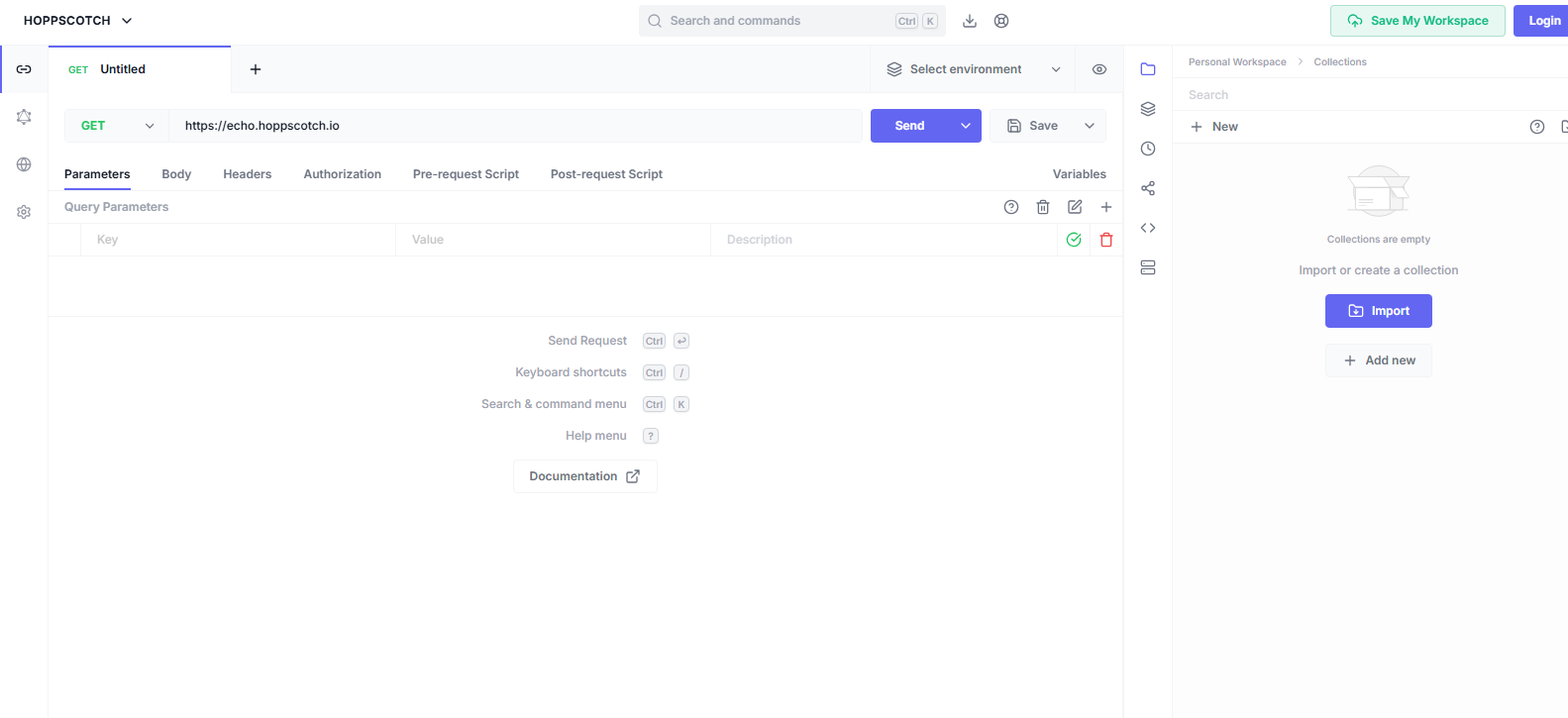
Hoppscotch is an open-source API development and testing tool for browser-based applications and can be described as a lightweight web-based API development suite. It helps developers with rapid compose and send http requests, exploring APIs and managing collections. The platform comes with security and privacy, with source code open and auditable.
Key Features
- Custom API requests
- Websocket & GraphQL support
- Lightweight & fast API exploration
- Debugging API endpoints
- Sharing simple API request connections
Tool #10 – Best AI-Powered API Testing Platform
Testim

| Characteristics | Testim |
|---|---|
| Best use case | AI-driven automated API and test maintenance |
| Core strengths | Self healing tests, AI-based test generation, Fast test stabilization |
| Who should use it | Engineering teams wanting to reduce test maintenance overhead using AI |
Testim is an AI-driven automated testing platform that offers functional UI test automation for web applications. This platform offers AI-powered agentic test automation to create better tests automatically accelerating the quality of an entire API lifecycle. It offers end-to-end testing from release to production testing with every code check-in.
Key Features
- Strong UI Automation
- AI-based self healing tests
- Comes with end-to-end workflows
- Robust CI/CD Integration
- Low-code & full-code support
The Bottom Line
In this complex and 24/7 proactive digital economy, companies will shift from standalone testing to integrated AI-powered lifecycle platforms to ensure reliable software delivery. These postman alternative API management tools have advanced and updated features and functionalities to assist teams with robust API lifecycle management. The future is combined with manual exploration and autonomous AI-driven automation.