Introduction
You might have a great mobile app and interesting features with notable functionality, but that’s not enough to find a relevant audience in this highly competitive era. Your business needs to create effective marketing strategies in order to bring organic traffic and attract relevant audiences to your application. Once you can bring an audience to your platform, you need to retain them with impressive features, functionality and highly engaging content on your platform and social networks. To do all this, your business needs mobile app marketing strategies.
Now, let’s understand what exactly mobile app marketing strategies are?
Mobile App Marketing Strategies: Well, businesses all across the globe need to attract relevant traffic to app products, which is why creating social networks and digital marketing strategies to bring organic traffic and attract a relevant audience is considered a mobile app marketing strategy.
Now, let’s learn about 10 powerful strategies for mobile app marketing.
10 Powerful Strategies for Mobile App Marketing
1. Define Your Target Audience
First of all, find out the target audience and identify potential segments of users who might be interested in applications like your business and you can easily attract a relevant audience base. Address pain points and user behaviors of your audience to understand what they want and extend core functionality of your app with those additional features and functionality. Based on demographics, interest and user patterns, create user personas and diverse segments to directly address their issues. For instance, imagine you own a coffee shop where you need to study your customers: students will expect affordable coffee, office workers will want quick takeaway coffee and families prefer comfortable seating and snacks.
2. Optimize Your App Store Presence
Implement app store optimization by targeting relevant keywords, and ensure your application is performing effectively without causing any inconvenience. Make sure you write a clear and keyword-focused title and description of your application by targeting high-volume relevant keywords. Upload high-quality screenshots and app previews to attract customers from the play/application store and encourage customers to rate and review your application and interact with them. Test your app and improve conversions. For instance, imagine you own a local bakery where instead of simply writing “Donna’s Bakery” you clearly mention the description “Donna’s Bakery – Fresh Cakes, Birthday Cakes & Pastries”. This allows them to attract customers.
3. Build a Strong Pre-Launch Marketing Plan
To catch attention and bring organic traffic of potential customers, start creating hype with online marketing before the app launch. Create a landing page and an email signup for customers to pre-register for early access to your application. Build online anticipation through social media to attract customers and use beta testing to collect early feedback. After that, create a launch-day promotion for the marketing plan. For instance, imagine you create a study app for students, but instead of just creating and launching the app, you create hype on social media with the “get early access” button, collect emails, give students early versions to test and offer special benefits to create an audience base.
4. Use Social Media Marketing
Find out which social network or platform your target audience most frequently uses and what kinds of material they interact with most frequently. Use these channels to promote your application’s features, tutorials, advantages, advice, and updates in order to draw in viewers and interact with possible clients. To draw in organic traffic and win over devoted clients, use user-generated and short-form content. Launch social media advertising campaigns by collaborating with relevant artists and influencers. For Example, imagine you own a fitness centre. Instead of promoting your content everywhere, you focus on fitness, health and relevant platforms where your target audience lives and create and share your content like healthy meal ideas, workout tips and more to attract relevant traffic.
5. Invest in Paid App Advertising
You need to invest in paid advertising as well by using Google, Meta and other relevant ad platforms to rank higher. You can run app-install and conversion campaigns to attract an audience with lucrative advertisements. Make sure you are targeting users based on their interests and behaviours to attract relevant traffic and convert them into loyal customers. Test ads via A/B testing and other creatives and keep a record of cost per install and return on ad spend. For Example, you’ve created a study planner app for university students. Now, instead of one advertisement campaign, you run two campaigns A). Forget homework deadlines? Try this simple Study Planner B). Prepare for exams with a smarter study schedule and you find out that ad campaign A brings more downloads than you invest more into campaign A).
6. Use Content Marketing to Attract Users
Create and publish blogs, guides, videos and tutorials on social media networks to attract traffic from the web. Spread awareness about common problems that your application solves, leveraging social media through content marketing. Use relevant search keywords and create & share content around it on your marketing channels. Build trust among the audience via content before asking users to download your application. For Example, imagine you have a bakery; instead of posting buy our cakes you create valuable and engaging content like “how to choose the right birthday cake”, “5 popular cake flavors for kids” and more with relevant keywords and rank higher.
7. Use Influencer and Creator Marketing
Find well-known creators who match your target audience and collaborate with them to perform influencer marketing for your application. Make sure to chase relevance instead of follower counts to attract organic traffic. Demonstrate how real problems can be solved by your application. Use reviews, tutorials and product demonstrations to showcase app benefits. Track and download conversions from creator campaigns for future influencer marketing. For Example, imagine your company has developed an AI-powered project management application. Now instead of going to every other influencer, the company finds relevant influencers to promote the app to easily reach relevant audiences.
8. Encourage Reviews, Ratings, and Referrals
Ensure satisfied users leave ratings and reviews and get feedback from unsatisfied users to improve your app. Make referrals simple and reward your customers for earning referral points. You need to create a referral or invite a friend program which encourages your users to bring potential customers to your application. Make sure you reply to negative reviews professionally and take action to improve your app accordingly. Use positive reviews as social proof in marketing. For Example, imagine you run a gym centre where you run a referral program. If anyone brings their 3 friends, you give them a special discount on the next subscription payment.
9. Focus on User Engagement and Retention
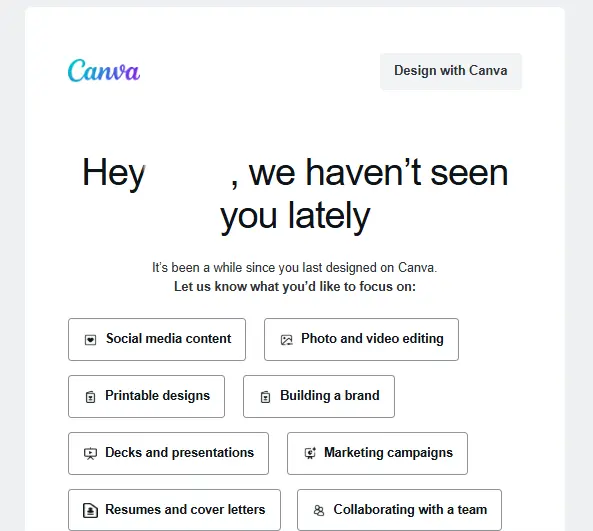
By delivering customized alerts about features, programs, reminders, and other significant updates, you can keep your users interested by sending in-app messaging. You must offer in-app prizes, upgrades, and customized experiences to your clients in order to boost their retention percentage. Give new customers an onboarding app demo tutorial that walks them via the features and capabilities of your program. For Example, see this Canva template for a re-engagement technique.
10. Measure, Test, and Improve Your Marketing
Ensure you keep a record of all the activities, including downloads, activation, engagement, retention and revenue, for effective marketing campaigns to use these data insights for future marketing campaigns. Leverage these data insights to understand user behavior and create segment groups to target specific types of audiences with A/B testing marketing campaigns, creatives and landing pages, best-performing acquisition channels and to continuously optimize your app marketing strategies. For Example, a business keeping track of content, ad campaigns, sales and marketing strategies can improve funnel performance.
Conclusion
With the assistance of mobile app marketing strategies, you can drive downloads along with app store optimization, content, social media, paid campaigns, influencers and retention strategies to bring relevant organic traffic and convert them into leads. Measuring results and improving app marketing strategy is crucially important to keep users engaged and attract users from different digital channels.