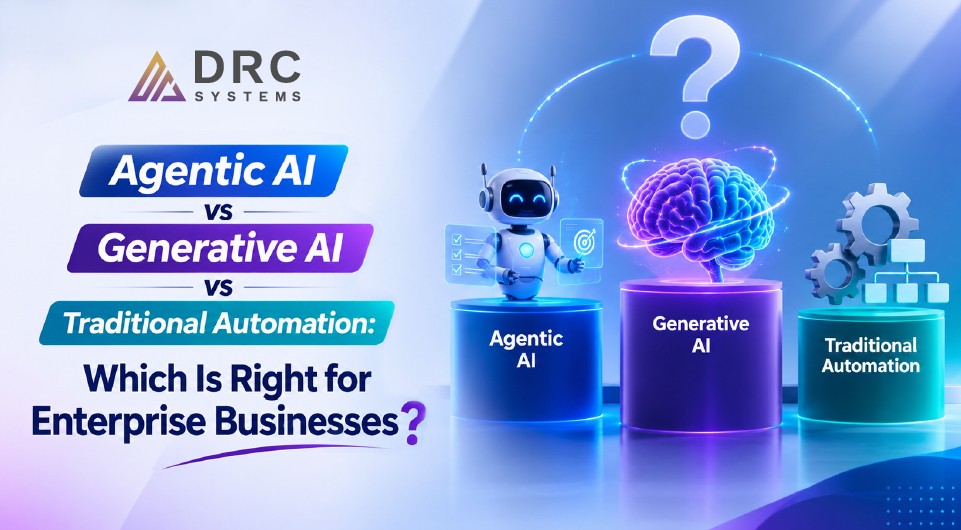
Agentic AI vs Generative AI has transformed work automation with smart intelligence going beyond traditional rule-based automation. The old days are gone, when developers had to go through a lengthy and complex development process to build explicit, hand-coded logic, boolean statements and structured decision architectures. In recent days, businesses rely on LLMs or AI agents to complete tasks through smart automation: unstructured data enrichment, sentiment analysis or OCR before passing clean data into a rule engine. In the upcoming days, businesses will use hybrid orchestration of AI, natural language prompt-to-automation generation and goal-based automation agents.
In this blog, let’s learn about the difference between agentic AI vs generative AI vs rule-based automation…
Agentic AI vs Generative AI vs Traditional Automation
What is Agentic AI?
Definition:
Agentic AI is a step forward from simply giving answers to the question. It helps users complete the end goal by making a plan, taking action and checking the outcome. Businesses all across the world today are investing in agentic AI to complete repetitive manual tasks to save time and money.
Example:
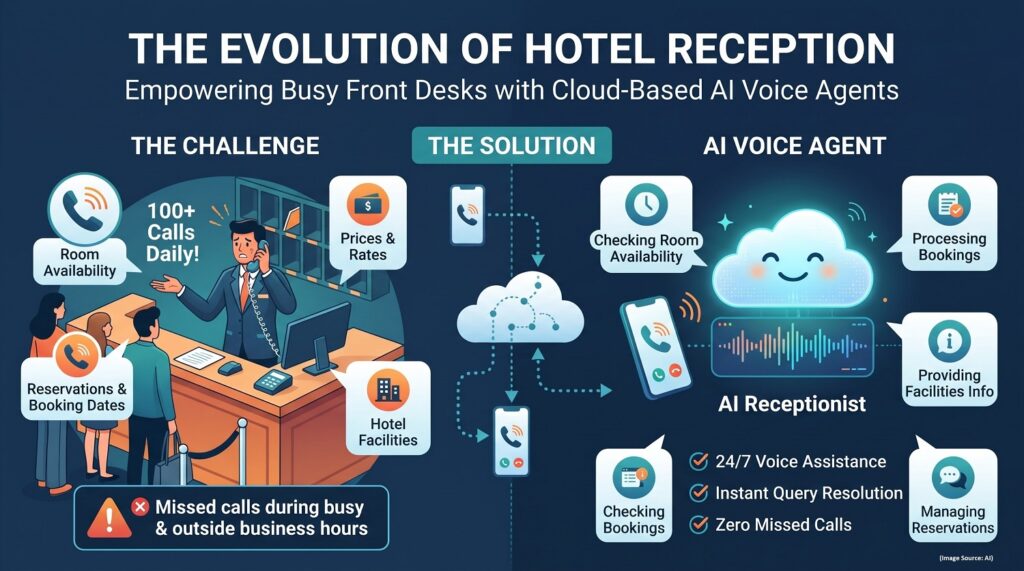
For example, imagine a hotel receptionist working at the front desk who is required to answer 100 phone calls every day regarding room availability, room prices, reservations, booking dates, and hotel facilities, which results in missed calls during busy hours and outside business hours, where agentic AI, such as voice assistance like Zanus plays a vital role in attending to those calls and resolving users’ queries. AI voice agent Zanus is a cloud-based AI receptionist and voice agent platform by Zanus AI.
Future:
Today, AI provides information, writing, research and suggestions. Agentic AI in the upcoming days will perform business tasks, coordinating with other AI agents to complete tasks, where humans will manage objectives, decisions and accountability.
Hire AI/ML Developers from DRC Systems!
Connect With Us!
What is Generative AI?
Definition:
Generative AI or Gen AI is a form of Artificial Intelligence that helps users generate any type of original content by simply giving a prompt to AI assistance, which, in response, will generate the type of content instructed by the user. You can generate any file format, including images, audio, videos, PDFs, and code.
Example:
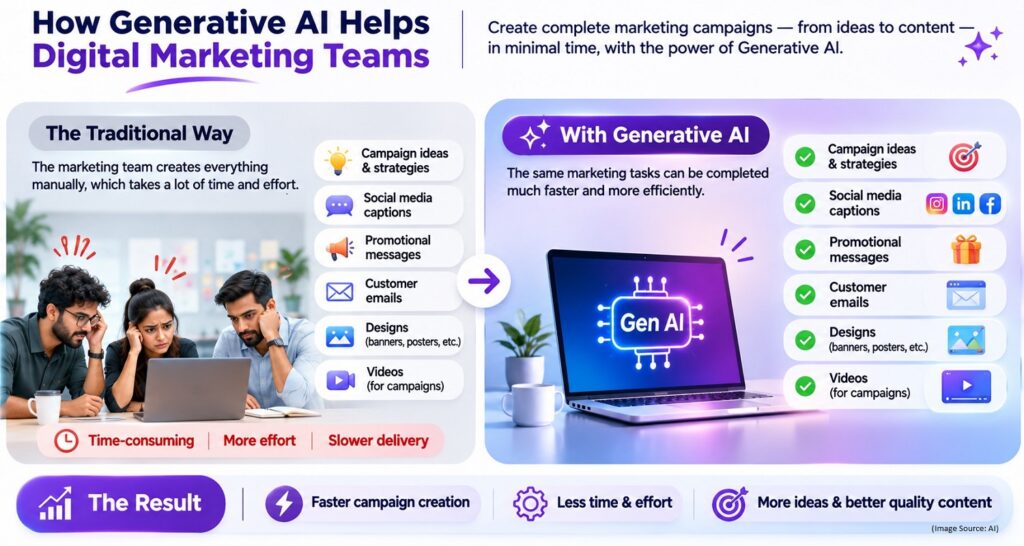
For example, imagine a digital marketing team needing to create a marketing campaign targeting young professionals. They need to create reliable campaign ideas and strategies, social media captions, promotional messages, customer emails, designs and videos for campaigns manually. Generative AI helps marketing teams complete all these tasks in minimal time, eliminating extra time and effort.
Future:
Generative AI is transforming from the traditional way of AI generating basic text and image creation to autonomous execution, smaller and efficient models and deep industry integration.
What is Traditional Automation?
Definition:
Traditional automation is hand-coded logic or rule-based robotic process automation that automates the workflow relying on if/then statements. It is a rule-based task execution that completes repetitive manual tasks with minimal human intervention.
Example:
The most common example of traditional automation is a confirmation and thank-you email to customers who submit the enquiry forms on the website. Businesses automate email responses to cut down on the extra time and effort to send confirmation emails to their customers after an enquiry.
Future:
Traditional automation is evolving, with time being a foundational layer and the future is not about replacing traditional automation but combining both. Businesses need to choose the right technology for the right type of work.
Agentic AI vs Generative AI vs Traditional Automation: Which One Is Right for Enterprise Businesses?
| Feature | Traditional Automation | Generative AI | Agentic AI |
| Primary Role | Rigid Process Execution | Content Creation & Synthesis | Autonomous Task Completion |
| Behavior | Deterministic/Fixed | Reactive | Proactive |
| Task Scope | Single, Repetitive Rule-Based Jobs | Bounded, Single-Turn Outputs | Complex, Multi-Step Workflows and Planning |
| Adaptability | None | Adapts Style and Tone Within a Single Response | High |
| Tool & System Use | Fixed Integrations or APIs | No Direct Tool Use by Default | Actively Calls External Tools, APIs, and Multi-Agent Systems |
| Human Oversight | High | High | Low to Moderate |
AI Agents vs Traditional Automation
Traditional automation uses its own set of fixed rules and if/then statements to execute tasks, while AI agents use reasoning, memory and context to dynamically complete the given goals in real time.
Enterprise AI Agents Usecases
- Human resource and employee operations
- Customer Support and IT Management
- Sales & Marketing
- Software Engineering and IT Automation
AI Workflow Automation for Businesses
Businesses use AI to automate workflows so that repetitive manual operations may be completed more quickly and efficiently. It increases productivity by automating all repetitive operations that need little human participation using agentic AI technologies.
AI Agent Implementation Challenges
- Context management & Memory limitations
- Tool Integration & API Orchestration
- Reality & Hallucination Risks
- Scalability & Infrastructure Cost
Conclusion:
Agentic AI vs Generative AI vs Traditional Automation selection for enterprises relies on types of tasks and workflow in order to maximize efficiency. As we’ve covered all the topics regarding this technology which might sound suitable for you, DRC Systems can help you with a free consultation regarding your agentic AI requirements.
Please do not hesitate to connect with us!
FAQs:
Que: Which technology should I choose for enterprise business?
Ans: Agentic AI vs Generative AI vs Traditional Automation: all three fulfil slightly unique end goals from one another as an enterprise business. You should analyze your requirements and choose traditional automation for predictable, repetitive and rule-based tasks and choose Agentic AI for complex autonomous workflows; and choose Generative AI for automation, augmentation and acceleration tasks.
Que: Why compare Agentic AI vs Generative AI vs Traditional Automation?
Ans: Comparing these tech methodologies helps organizations choose the right one that aligns with their workflow based on autonomy, structure and complexity.
Que: Can you describe the main difference between Traditional Automation, Generative AI and Agentic AI?
Ans: Traditional automation relies on hand-coded logic, if/then statements or robotic process automation (RPA) scripts. Generative AI uses large language models trained on enormous datasets to identify patterns and generate human-like text, summaries, images or code.
Que: Is traditional automation dead?
Ans: No. Traditional automation is evolving and getting assistance from AI agents to deliver the best results for workflow automation efficiency.
Que: What is the 70/30 rule in AI?
Ans: The 70/30 rule in AI suggests that AI handles 70% of pattern-based and data-heavy tasks while humans retain the remaining 30%, giving critical judgement, empathy, strategy and ethical oversight.
Que: What are the benefits of agentic AI?
Ans: 1). Increase efficiency 2). Faster operations 3). Enhance decision-making 4). Enables scalability and personalization
Que: Is ChatGPT a GenAI?
Ans: Yes, ChatGPT is a GenAI.